
Buying a used pontoon boat directly from the owner is one of the best ways to land a great deal. You get the full history straight from the person who loved and used it. This guide is your complete roadmap, designed to help you confidently navigate every step, from spotting a quality listing to closing the deal like a seasoned pro.
Your Guide to Private Pontoon Boat Sales
Diving into the private-party market can feel like finding a hidden cove of opportunity. You get to connect directly with sellers, ask all the detailed questions you want, and potentially save thousands compared to boat dealership prices. It’s your chance to get the boat’s full story, straight from the source.
Of course, this approach puts you in the captain's chair for the whole process. You become the chief inspector, the negotiator, and the fact-checker. Without the safety net of a marine dealership or broker, it's on you to verify the boat's true condition and make sure all the paperwork is squared away.
The Growing Private Seller Market
The appeal of buying from an owner is stronger than ever, partly because the pontoon industry itself is absolutely booming. The global pontoon boat market was pegged to be worth around $2.5 billion in 2025, and it’s projected to grow by about 5% every year through 2033.
This massive growth creates a really active secondary market where owners are selling their boats directly. If you want to dig deeper, you can find more industry research on pontoon boats to see the full picture.
What does this mean for you? More options. As current owners upgrade to the latest models or their boating lifestyle changes, a steady stream of well-maintained used pontoons hits the private market.
Key Takeaway: Buying from an owner means you're not just getting a boat; you're often inheriting a vessel that was a cherished part of someone's family. That emotional connection frequently translates to much better maintenance and care.
What This Guide Covers
Think of this guide as your personal playbook for mastering the private sale. We’ll walk you through everything you need to know to make a smart buy and steer clear of the common traps.
- Finding and Vetting Listings: Learn the best places to look for quality private listings and how to spot red flags in an ad before you even pick up the phone.
- Inspections and Sea Trials: We’ll give you a detailed checklist for both on-land and on-water evaluations to uncover a pontoon's real condition.
- Negotiation and Paperwork: Get ready to master the art of making a fair offer and learn exactly what legal documents you need for a smooth title transfer.
Our goal here is simple: to give you the confidence and knowledge to find a pontoon that will be the centerpiece of family fun for years to come.
How To Find And Vet Private Pontoon Listings
Finding a great used pontoon starts with knowing where to look and, just as importantly, how to read between the lines of an ad. The absolute best deals on boats for sale by owner rarely pop up on the first page of a Google search. You have to dig a little deeper, into the places where real boaters hang out.
These spots connect you directly with a community of dedicated owners, bypassing the generic marketplaces. Understanding the pros and cons of each source is the key to focusing your search and finding a pontoon that's been genuinely cared for.
Where To Uncover Quality Listings
Your search should be a mix of the big, high-traffic sites and the smaller, niche communities. Each one offers a different kind of boat and a different type of seller.
- Marine-Specific Marketplaces: Websites like Boat Trader are the undisputed champions here. They're built for one thing: selling boats. The detailed filters for length, year, engine type, and location let you slice and dice the inventory to find exactly what you're looking for.
- Owner Forums and Clubs: This is where you find the hidden gems. Enthusiast forums for specific pontoon brands (think Bennington or Harris) are gold mines. Owners on these sites are often incredibly meticulous about maintenance and are usually happy to walk a fellow enthusiast through the boat's entire history.
- Local Marinas and Yacht Clubs: Never underestimate the power of an old-school bulletin board. Marinas are community hubs, and sellers often tack up a flyer for a boat that's docked just a few slips away. This can be the easiest way to get a quick, initial look at a boat.
A crucial first step is setting up saved searches and alerts on the major digital platforms. A desirable, well-priced pontoon can be gone in a matter of days, so being one of the first people to see a new listing gives you a massive advantage.
Comparing Private Pontoon Listing Sources
Finding the right boat means looking in the right places. Each platform has its own unique flavor, from massive online marketplaces to the local marina bulletin board. Here's a quick breakdown to help you navigate the options.
| Source Type | What to Look For | Potential Pitfalls |
|---|---|---|
| Online Marketplaces | A huge volume of listings, advanced search filters, and boats from all over the country. Great for market research. | Can be impersonal, with many overpriced or poorly described listings to sift through. |
| Owner Forums/Clubs | Meticulously maintained boats, knowledgeable sellers, and often a complete service history. | Lower volume of listings, brand-specific, and you may need to be a member to view sales posts. |
| Local Marinas | Hyper-local listings you won't find online, plus the ability to see the boat immediately. | Limited selection, relies on luck and timing, and information on the flyer may be sparse. |
| Social Media | Great for finding local deals quickly. Listings can pop up and sell within hours. | Lots of scams, "tire-kickers," and sellers who aren't serious. Requires extreme caution. |
Ultimately, a mix of these sources will give you the best shot at finding a quality pontoon at a fair price. Don't put all your eggs in one basket; keep an eye on both the big sites and the local community spots.
How To Dissect An Advertisement
Once you’ve got a promising listing in your sights, it's time to put on your detective hat. The ad itself—the photos, the description, the level of detail—tells a story about the boat and its owner long before you ever pick up the phone.
An owner who loves their boat usually puts love into their listing. Look for ads with plenty of clear, recent photos from every angle, including the engine, the upholstery, the console, and even inside storage compartments. On the flip side, a handful of blurry, distant photos is a massive red flag. For a deeper dive, you can explore the role of high-quality images in the marine industry, which explains why sellers who invest in good photography are often more transparent and serious about the sale.
A detailed, well-written description is a sign of a meticulous owner. Vague descriptions like "runs great, normal wear" should make you skeptical. You want specifics: "Engine oil and filters changed every 50 hours," or "Upholstery and flooring replaced two seasons ago."
Decoding Photos and Descriptions
When you're scrolling through the pictures, force yourself to look past the beautiful sunset in the background. Zoom in. Hunt for the little details that reveal the boat's true condition.
- Look for Consistency: Do all the seats match perfectly? A single mismatched cushion could indicate a quick patch job to cover up significant damage or rot.
- Check for Water Lines: A nasty scum line high up on the tubes? That could mean the boat spent most of its life sitting in the water, which opens the door to more marine growth and potential corrosion issues below the deck.
- Examine the Background: Pay attention to where the boat is stored in the photos. Is it tucked away in a clean, covered space, or is it sitting on flat tires in a neglected corner of the yard? The storage environment speaks volumes about the level of care it received.
Non-Negotiable Questions For The Seller
Before you waste an afternoon driving across the state, a quick phone call can help you screen the listing and the owner. This isn't an interrogation; it's a simple fact-finding mission to make sure the boat is worth pursuing.
- "Why are you selling the boat?" It's a simple question, but the answer can be incredibly revealing. Good answers are things like upgrading, downsizing, or moving away from the water. Hesitation or a weirdly complicated story could be a warning sign.
- "Do you have the title in hand, and is it in your name?" This one is non-negotiable. If the seller doesn't have a clean title, in their possession and in their name, just walk away. It's not worth the massive legal and financial headaches you'll face later.
- "Can I see the maintenance records?" A responsible owner will have a folder, even a messy one, with receipts for engine service, winterization, and repairs. A complete lack of records suggests maintenance was either inconsistent or done by a DIYer with questionable skills.
Asking these key questions upfront helps you quickly separate the serious, responsible owners from someone just trying to offload their problem boat. It saves you a ton of time and ensures you only focus on legitimate opportunities to find the perfect used pontoon boats for sale by owner.
The Complete On-Land Pontoon Inspection
The on-land inspection is your single best chance to uncover a pontoon’s secrets before you even think about putting it in the water. This is a hands-on process where you’ll look, touch, and test almost every part of the boat. Getting this right is your best defense against buying someone else's problems.
This visual guide breaks down the process into three key stages you should always follow.
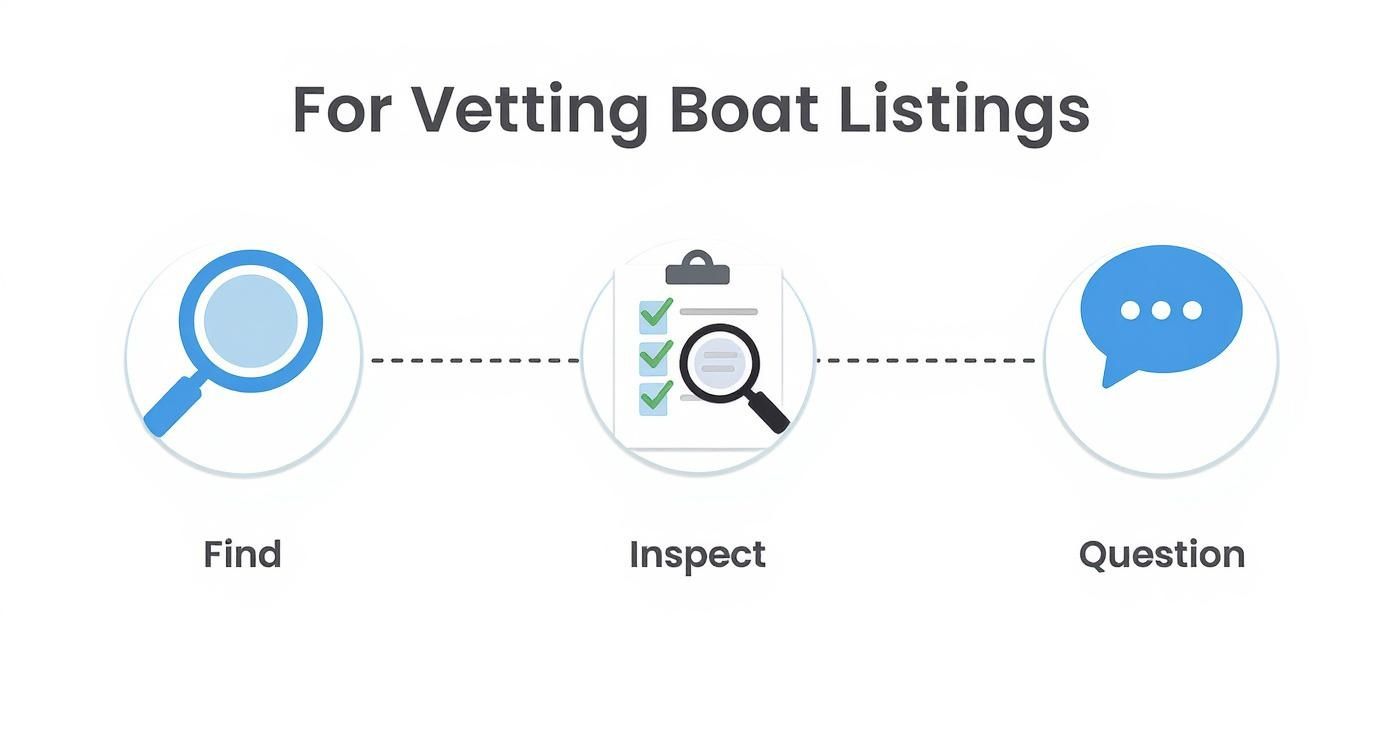
The flowchart highlights that a successful purchase begins with diligent searching, followed by a meticulous inspection, and is finalized by asking the right questions.
Assessing the Pontoons and Underside
Start your inspection with the most foundational part of the boat—the tubes. Crouch down and get a good look at the entire length of each pontoon, paying close attention to the welds and seams. Look for any signs of damage, like large dents, deep scratches, or evidence of sloppy repairs.
- Corrosion Check: Look for pitting or excessive oxidation, especially around brackets and where the tubes meet the cross-members.
- Weld Integrity: Welds should be smooth and consistent. Any cracked or re-welded areas are major red flags that could point to structural stress.
- Keel Strips: Check the protective strips on the bottom. Missing or heavily damaged strips can suggest the boat has been frequently beached or run aground.
While you're down there, inspect the cross-members that support the deck. Significant corrosion here can compromise the boat’s entire structure, leading to an expensive and difficult repair. It’s an area many buyers overlook, but its integrity is paramount.
The Deck and Flooring Soft Spot Test
Next, climb aboard and get a feel for the deck. Walk slowly around the entire perimeter and across the middle, paying close attention to how it feels under your feet. You are performing the crucial "soft spot" test.
Any area that feels spongy, bouncy, or soft is a dead giveaway that the plywood subfloor has water damage and is rotting. Pay extra attention to the corners, around seat bases, and near the transom where the engine is mounted. Replacing a rotted deck is a massive job, and it’s one you want to avoid at all costs.
Pro Tip: Don’t be shy about this. Tap your foot firmly in different spots. The deck should feel solid and uniform everywhere. If the owner seems hesitant to let you do a thorough walk-around, consider it a warning sign.
The condition of the vinyl or carpet on top can also offer clues. Peeling vinyl or stained, moldy marine carpet can indicate moisture is trapped underneath. Even if the flooring looks good, the real story is told by the subfloor's structural integrity.
Furniture Upholstery and Canvas Condition
Now, turn your attention to the furniture. UV rays and moisture are the biggest enemies of marine upholstery. Examine every cushion, seatback, and sun pad.
- Stitching and Seams: Look for threads that are frayed, broken, or pulling apart. This is often the first place sun damage shows up.
- Cracks and Fading: Check for vinyl that is brittle, cracked, or severely faded. Press on the cushions to ensure the foam inside is still firm and not waterlogged.
- Hidden Mold: Lift the seat cushions and look underneath. Mildew and mold love to hide in these dark, damp spaces and can be a sign of poor upkeep or a leaky boat cover.
Don’t forget the Bimini top and any canvas covers. Open and close the Bimini to make sure the frame operates smoothly and isn't bent. Inspect the canvas for rips, torn seams, or areas where it has become thin and brittle. A good cover is essential for protecting your investment, and a worn-out one will be an immediate expense.
The increasing popularity of specialized pontoons, like those designed for fishing, means you might find specific features to inspect. The global market for fishing pontoon boats is expected to grow by about 15.2% annually through 2032, driven by anglers who value their stability and space. This means many used boats now include livewells, rod holders, and fish finders, all of which should be carefully inspected. You can explore more about the growth of the pontoon market to see how these trends are shaping buyer options.
Systems Check: Fencing, Gates, and Motor Mount
Finally, do a thorough systems check. Start at the helm and flip every single switch. Test the navigation lights, courtesy lights, horn, and any accessories like a stereo or livewell pump.
Check the fencing and gates. Shake the panels to ensure they are securely fastened and not rattling excessively. Open and close every gate, making sure the latches work properly and securely. This is a critical safety feature, especially if you'll have kids or pets on board.
End your on-land inspection at the transom. Carefully examine the motor mount area for any stress cracks in the aluminum or welds. This area takes a lot of force, and cracks can indicate the boat was overpowered or operated roughly. A compromised transom is a deal-breaker for any savvy buyer.
Negotiating the Price and Closing the Deal
You’ve done the hard part—the inspection is complete, the sea trial went off without a hitch, and you’re pretty sure this is the boat for you. Now for the step that makes most folks a little nervous: talking numbers and handling the final deal. Don’t sweat it. A little preparation and a calm, friendly approach will help you land a fair price and make sure the transfer of ownership is buttoned up and legal.
First thing to remember: you're dealing with a private seller, not a boat dealership. This person likely has an emotional connection to their boat. They’ve made memories on it. So, your negotiation needs to be respectful and based on facts, not an aggressive back-and-forth.
Building Your Data-Backed Offer
Never walk into a price negotiation based on gut feelings. Your offer needs to be grounded in the reality of the market. This not only protects you from overpaying but also shows the seller you've done your homework.
- Find the Comps: Jump on a marketplace like Boat Trader and look for similar pontoon boats in your area. You want to match the year, make, model, length, and engine horsepower as closely as you can. Also, pay attention to how long those other boats have been for sale.
- Grade the Condition: How does the boat you’re looking at stack up against the listings you found? Is the upholstery in better shape? Does it have way more engine hours? You need to account for these differences when figuring out what it’s really worth.
- Use Your Inspection Notes: Remember that worn-out Bimini top? The batteries that looked like they were on their last legs? The trailer tires that are showing cracks? These are your negotiation points. Don't frame them as flaws or problems. Instead, present them as real, upcoming expenses you'll have to take on.
This completely changes the conversation. You’re no longer just saying, "I think it's worth less." You're saying, "I looked at three other boats just like this one, and considering it's going to cost me about $800 to replace the canvas, here’s what I’m prepared to offer." For a deeper dive into valuation, our guide on how to price a boat offers some great seller-side tips you can flip to your advantage as a buyer.
Key Insight: Always start the money conversation by telling the owner what you love about the boat. Acknowledging the care they've put into it creates a positive vibe right before you start talking about price adjustments.
Securing the Deal with Essential Paperwork
Once you and the seller shake hands on a price, the paperwork becomes the most important part of the entire process. Getting this right protects everyone involved and guarantees a clean transfer. Skimping on this step can lead to massive legal and financial headaches later.
A verbal agreement is great, but it won’t hold up. You absolutely need a detailed Bill of Sale. This document is your official receipt and is almost always required to get the boat titled and registered in your name.
To make sure you're covered, there are a few key documents you need to collect. Getting these pieces of paper in order is non-negotiable for a smooth, legal, and secure purchase.
Essential Paperwork for a Private Boat Purchase
| Document | What It Is | Why You Need It |
|---|---|---|
| Boat Title | The official legal document proving ownership of the vessel. | Verifies the seller is the legal owner and allows you to legally register the boat in your name. |
| Bill of Sale | A formal contract detailing the terms of the sale, signed by both buyer and seller. | Serves as proof of purchase and is required by the DMV or DNR for registration and title transfer. |
| Lien Release Letter | A document from a lender stating that any loan on the boat has been paid in full. | Confirms there are no outstanding debts against the vessel, ensuring you receive a "clean" title. |
| Trailer Title | If a trailer is included, it will have its own separate title and registration. | Required to legally register the trailer for road use. |
Don't forget to double-check that the Hull Identification Number (HIN) on all the documents matches the HIN stamped on the boat itself. A simple typo can create a huge mess. For extra security, getting the Bill of Sale notarized is a smart move, and some states actually require it.
Once all the papers are signed and verified, use a secure payment method. A cashier's check is a classic for a reason, but for bigger transactions, an escrow service can provide an extra layer of protection for your money.